2010-06-27

Buggy software is cheap enough

If software would be made bug-free, that would force prices to be so high that nobody could buy them. How so?

Well, let’s think about what it means to build bug-free software. There actually exists some software, which is built with goal of “zero-defects”. By that, I’m not referring to the constant hype from latest agile method cult who may have some extravagant claims. I mean software where it’s of utmost importance to really have no bugs, no matter the costs. A case where a single bug may mean loss of lives or failure of the whole project. This kind of software is built for space missions, nuclear facilities, and so on. And such a policy on quality is inherently very very expensive.

Imagine if Windows, for example, would have been built with such policy. It’s a really complex and huge piece of software compared to ones normally built with zero-defect policy. But, given the option, would you pay $19,900 of your operating system, if it would never crash? It’s quite a no-brainer that “everybody” would rather pick the same software for $199 and just put up with the few problems they encounter. (The price difference was picked by Stetson-Harrison method. It’s a guess to illustrate the point. The difference could be actually lot worse for niche market software which isn’t aimed for mass market.)

2010-06-09

Back from Japan

Fire station

I was away for about 2.5 weeks to visit Japan, more exactly Kyoto and Tokyo. The trip was excellent, and in retrospect it was clearly a good idea to visit both cities. While Kyoto is a modern city, it still has a bit more traditional feel to things. For example, the local laws forbid building tall skyscrapers, so there aren’t much taller buildings than we have in Helsinki.

Tokyo in other hand is very modern city with lots of skyscrapers. When going to see the city view from top of Mori building in Roppongi hills, you can see the city expands in every direction to the horizon as far as you can see. There is also extremely well developed public transportation, just check the Tokyo subway map (PDF). The public transportation in Helsinki is also quite good, but Helsinki is so tiny compared to a big metropolitan city so that our subway is tiny as well – just compare the above one to the current Helsinki metro map. ^_^

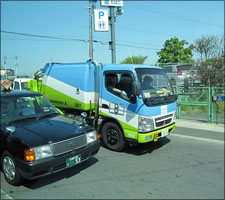
Small garbagetruck

Interestingly when going to USA it feels that everything is bigger. When going to Japan, it feels the opposite. Maybe that’s partly because there is a whole different class of small cars which are narrower than we’re used to. I think the average width of streets is a bit less as well. There are also typical big western cars, so there’s just more variety of different sized cars. There’s even mini garbage trucks as you can see. However, not everything is small; I think in Japan they just tend to make things small by default, but aren’t afraid of making things big when there’s a reason to do so.

Also some things seemed to be done in an opposite way of what we’ve used to. Not just the left-hand driving and walking, but cars are also almost always parked backing to parking spot so that it’s slower to park car but easy to leave. And at least in Kyoto the buses worked so that you go in from a single back door and pay when you exit through the front door. Curiously in Japanese language the verb is also put last in sentences (think of Yoda-speak).

2010-04-15

Smiling parenthesis in parentheses

Time for some trifling thoughts.

When writing you sometimes want to put a sidenote in parentheses, and then end it with a smiley.

This raises a question: Should you write one or two ending parentheses?

This seems to be an awkward problem for many. XKCD even made a comic about it (link at end of this post).

My solution is to use just a single parenthesis, so the ending parenthesis becomes part of the smiley. It just looks better that way! However, this way really sucks if you are writing in e.g. some chat system which automatically replaces smileys with small graphic icons. In that case the ending parenthesis just disappears and it feels like the sidenote keeps going on and on and the whole paragraph starts feeling unbalanced. So, if I know that the system will replace my smileys with icons, I will use double parenthesis.

At this point you’re probably wondering why I don’t show an example? I often overuse such sidenotes for some remarks, which is of course the reason I have even realized this earth-shattering problem. However, I have also realized that the best way to fix it is actually just to not use such sidenotes. Often the sidenote may actually be just a natural thing to say in the next sentence. Or perhaps you can consider using a footnote. I feel footnotes don’t work that well in web pages but I prefer them in print publications.

Anyway, I should save you the trouble (of constructing examples yourselves :).
Or maybe you already tried yourself (I know you did! :-) ).

XKCD comic

2024 EDIT: Above text was written in 2010. Just a few years later emojis gained popularity. Now they can be considered mainstream and generally available. When you can replace use of smileys with emojis, of course this whole issue more or less goes away.

2010-03-07

Zen Bound 2 Announced

ZB2
So it’s no longer a secret … at Secret Exit we’re working on Zen Bound 2 for the iPad.

Various sites have embraced the news eagerly such as IGN Wireless, CNET and Kotaku, to name just a few.

Be sure to also check Mikko’s blog post about a cardboard prototype.

Update Apr 3, 2010: iPad is now available in the US, and so is Zen Bound 2. Go get it!