This post is about echoes from the past—from 10, 20 and 30 years ago—and how they’re reaching 2022. In 1992, the Assembly demoscene event was born, as was a little not-so-serious joke demogroup called tAAt. In 2002, tAAt won the first Assembly Game Development competition. And in 2012 I made the decision about switching jobs and setting up a new company (which was officially founded just at the next turn of the year).
I just attended the Assembly Summer 2022 event, as I’ve done since 1992, so it’s been 30 years already. Since the event has now been held for 30 years, they did Assembly 30 Years awards. There were shortlist nominees in different categories, and audience had the chance to vote for their favorite in each one.
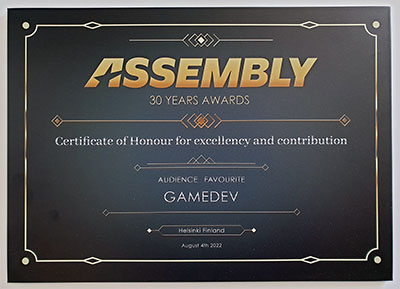
Incidentally, it’s now also 20 years since the release of the Porrasturvat – Stair Dismount, which was that game which won the first Gamedev compo at the event. And now, 20 years later, it was nominated in the above mentioned awards and even ended up winning the audience award in the Gamedev category! 😲 The Displate metal poster is shown in the image.
Funny enough, tAAt was also nominated in the shortlist of Impactful Group category. And like Assembly event, tAAt group is also now 30 years old, as its first release was made in late 1992. My friends also finished their Lego stop-motion animation trilogy, with the final version mostly made in 2002, but with the material only getting edited now in 2022. They won the Short Film competition once again. Check out LeGorski in YouTube. I had a very minor voice acting role. 😀
You might know that development of the Dismount game series is still continued, although I haven’t been personally involved with it for the last 10 years. But, at the award ceremony, my old colleagues still remembered me with their own award – a gift card for buying a concrete stairs element. 😵
Also, the Assembly event organizers asked me to do a little seminar presentation…
I agreed to do one – and you might almost guess the theme:
View “Making of Porrasturvat” presentation in YouTube.
If you check the video, you may notice that I used custom slideshow software. I’ve done that previously as well (here, here and here). This time I continued to tinker with my system, e.g. by adding multi-display support. When activated, it shows small slide with presenter notes on the primary display and full-screen slide on the secondary display. This is of course similar to what you’re used to with PowerPoint and other off-the-shelf presentation software.
Using custom slideshow software allows doing some unusual integrations like OSC integration, or embedding 3D models, and so on. If you’re interested in contracting me for something similar, please use the contact email address in Strobotnik Showcase page (Strobotnik is my consulting company).
PS. I might post the slides here a bit later, maybe with the executable version!
Temporary addendum:
I’m currently available for a new contract. Note that I only take part-time contracts. Check out these pages for some more background information: about me, Strobotnik Showcase.